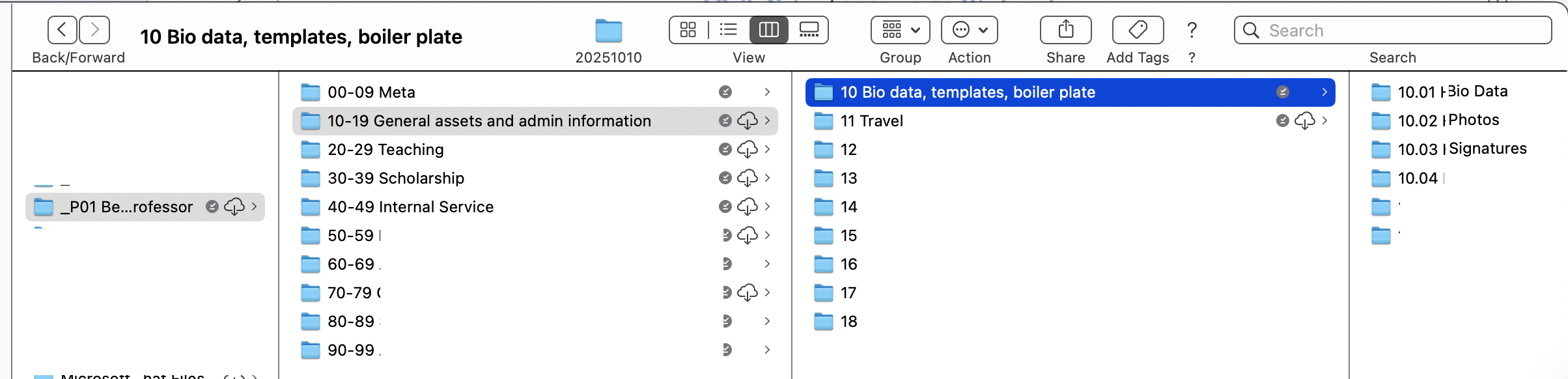
I’ve been using my systems now for over a year and half now and pretty happy. But it has occurred to me that maybe I’m not totally optimizing. Below is a screenshot of my file system. I have one of my systems set up with ten folders (for each area), with each area having up to ten folders (for categories), and then folders for each JD ID.
I have the usual JDex set up in the one ID per file mode in Obsidian, though am considering moving it to Bear.
My question is, should I just ditch the area and category folders to have a flatter organization with each ID just in its own folder under the system ID (I have two systems) relying only on my JDex as the Rosetta stone to organization?
There is a subsidiary question as well - currently in Obsidian, I have my JDex set up in a nested folder configuration rather than as a flat file of IDs relying on the search functions.
I don’t seem to recall an “in the weeds” question previously, so apologies if I’ve missed it and I look forward to the responses.
There are two separate but related questions. One is whether the files themselves should be flat or organized by Area (folder)>Category(folder). The other is whether the JDex in a one-note per ID system should be a flat set of index notes, or also organized hierarchically? I suspect (correct me if I am wrong) that the answer to the second question is a flat organization.
Even with the JDex question, people do both. It depends what app, if any, you use to manage it.
I use Obsidian for our work system and I like having the ‘partially nested’ config where each category’s files are in the category folder. But some prefer having them all just flat.
No right answer. Adapt to your needs & preferences.
So far for me it is 100% dependent on where my ID’s live. So I use two main tools and a third tool.
Super Productivity: it is the default tool for collecting quick info, because most of my incoming is tasks anyways it makes sense that a sentence or two would suffice with priority & timing being the most important factors.
Anytype: This is an interesting one to setup for a DEX but it has a powerful search and many useful built in tools so it is turning out to work very well for a more encompassing tool.
The somewhere inbetween tool is simplenote where I can catch incoming information but if it is something that requires a bit more text it is far easier to search that super productivity.
Each of these tools has a diffierent ability for complexity. Simplenote is flat as could be, Super productivity allows folders and hierarchy but it is actually not very effective, and anytype is like building a tunnel in whatever direction you collect information. Use full ID’s and working backwards seems to be the motto for keeping everything playing nice.